Marcia Anderson, Associate Broker | Realtor    
Sunbelt Realty    

480-560-0450    
MarciaAnderson6@yahoo.com    
    
Let's Stay Connected on Facebook & Twitter!


Wednesday, June 27, 2012

Existing-Home Sales Constrained by Tight Supply in May, Prices Continue to Gain


 Limited supplies of housing inventory held back existing-home sales in May, but sales maintained a strong lead over year-ago levels and home prices are on a sustained uptrend in all regions, according to the National Association of REALTORS®.
Total existing-home sales, which are completed transactions that include single-family homes, townhomes, condominiums and co-ops, declined 1.5 percent to a seasonally adjusted annual rate of 4.55 million in May from 4.62 million in April, but are 9.6 percent above the 4.15 million-unit pace in May 2011.
Lawrence Yun, NAR chief economist, said inventory shortages in certain areas have been building all year. “The slight pullback in monthly home sales is more likely due to supply constraints rather than softening demand.

Wednesday, May 2, 2012

MLS #: 4489967
Listed by: Sunbelt Realty & Business Advi
10785 E HERITAGE CT 1608
Scottsdale, AZ 85255
$1,690,000
Private 2 + acre lot in gated Upper Canyon of Silverleaf Country Club. Surrounded by the McDowell Sonoran Preserve, the lot has spectacular mountain, golf, and city light views. Large building envelope (38,598 sf) requires minimal site prep to build. Cul-de-sac lot with neighboring homes valued at more than $8 million. This lot offers UNOBSTRUCTED VIEWS!! Survey has been completed and site plan is available under the documents tab.
Marcia Anderson
Sunbelt Realty
10605 N Hayden Rd #G120
Scottsdale, AZ 85260
480-560-0450
http://www.MarciaAndersonRealtor.com
Property Characteristics:
  • Apx Total Acres: 2.09
  • Existing Land Use:
    Residential Lot
    Residential Acreage
  • Zoned Presently:
    Single Family

March Pending Home Sales Rise, Market Recovering


Pending home sales increased in March and are well above a year ago, another signal the housing market is recovering, according to the National Association of REALTORS®.
The Pending Home Sales Index, a forward-looking indicator based on contract signings, rose 4.1 percent to 101.4 in March from an upwardly revised 97.4 in February and is 12.8 percent above March 2011 when it was 89.9. The data reflects contracts but not closings.
The index is now at the highest level since April 2010 when it reached 111.3.

Monday, March 5, 2012

Upbeat findings for Arizona housing market

Metro Phoenix home prices are up. Fewer inexpensive homes are for sale, and the number of pending foreclosures is down.
The positive housing-market update comes from Arizona State University's newest real-estate report.
It's the first monthly housing analysis from Mike Orr, who was recently named director of the Center for Real Estate Theory and Practice for ASU's W.P. Carey School of Business.
Single-family home prices overall in the Phoenix area have been moving up since they reached a low point in September," Orr said in his debut monthly housing report.
"Also, looking forward, I expect a declining trend in foreclosures."
Orr also publishes a daily online analysis of Phoenix-area housing indicators called the "Cromford Report."
The median price of all home sales, including new homes, reached $120,500 in January of this year, Orr reports. That compares with $113,166 a year earlier.
The average price per square foot of Valley houses has climbed 3 percent since last year.
There were approximately 8,000 new and used homes sold in January, up from 7,500 in January 2011.
Orr said investors have snatched up the oversupply of homes for sale under $300,000.
"Many people think there's a glut of homes the banks are hiding somewhere, and that may be the case in other markets, but not here in the Phoenix area," he said.
"We've gone through so many foreclosures that the system has been working itself out for about five years."
In January, there were 2,450 single-family foreclosures in both Maricopa and Pinal counties, compared with 4,200 during January 2011, according to the ASU report.
The supply of homes listed for sale in metro Phoenix is down 42 percent from a year earlier.


Read more: http://www.azcentral.com/business/realestate/articles/2012/02/23/20120223report-upbeat-findings-arizona-housing-market.html#ixzz1oGssJWfa

by Catherine Reagor - Feb. 23, 2012 06:35 PM
The Arizona Republic | azcentral.com


Monday, February 13, 2012

Foreclosures hit 4-year low in Phoenix metro area

New data indicate that the number of Phoenix-area homes taken back by lenders in January fell to its lowest level since early 2008.
Last month, there were 2,263 foreclosures, or trustee sales, in the region, according to real estate   research firm Information Market. Pre-foreclosures, also known as notice of trustee sales, fell to 2,932, the lowest level since the summer of 2007.
A year ago, both foreclosures and pre-foreclosures were double what they are now. The number of pending foreclosures is one-third of what it was a year ago. Only 15,000 active foreclosures are making their way through the process now.
Some housing analysts continue to talk about shadow inventory, characterized as essentially unexpected foreclosures that will hit the market just as it begins to recover. But that phenomenon can't be tracked now.
Tom Ruff, analyst with Information Market, tracks notice of trustee  sales, trustee sales and homes sold at the foreclosure auction daily. He said he sees no sign of a shadow-inventory problem in metro Phoenix.
The region's mortgage-delinquency rate has also fallen during the past year, meaning fewer homeowners are falling behind on their payments. Some market watchers say banks just aren't moving on many foreclosures and are not reporting all the loans borrowers are missing payments on, but lenders deny this.
So going by the numbers and word of lenders, it looks like the worst of metro Phoenix's foreclosure crisis is behind it.
Economic barometer
The southeastern corner of 25th Street and Camelback became a Christmas-tree lot in the mid-1980s during an office-construction boom in metro Phoenix, and the first Esplanade tower went up west of it. Then came the real-estate crash of 1990. The lot at 25th Street remained empty except around the holidays.
As the Phoenix office market rebounded in the mid-1990s, the lot was developed into a shopping center with an athletics store and two popular eateries, the Hard Rock Cafe and Marco Polo Supper Club.
But then came the slight downturn from the dot.com bubble, and by 2003, the center's stores and both restaurants had closed. Developer Donald Trump proposed a high-rise resort for the corner during the boom in 2005 but walked away from the project in 2006.
Last year, Alliance Residential bought the lot out of foreclosure.
The firm is building a 270-unit upscale-apartment complex there.

by Catherine Reagor - Feb. 3, 2012 02:39 PM
The Arizona Republic
 

Wednesday, January 11, 2012

Top 5 Reasons to Buy a Home in 2012


iStock Couple houseXSmall Top 5 Reasons to Buy a Home in 2012 
    The American dream of homeownership is a very feasible aspiration for 2012.
                                                                                                                                                               
There are many benefits of owning a home. Yet some first-time buyers are skeptical of purchasing with the uncertainty surrounding the housing market.
The uncertainty many reference when speaking about the housing market involves a specific date when home values will increase. Since no one can pinpoint this date, the word uncertainty (when paired with the housing market) often reveals a negative connotation.
There are some factors we can be certain about in this housing market such as home values rebounding. This is true; the housing market often moves in cycles.
It’s safe to assume that many Americans harbored the same uncertainty during the George H. W. Bush administration in the early 1990s when the national homeownership rate fell from its previous historic high of 64.4 percent in 1980 to a low of 64.1 percent in 1991.
In the 1960s Lyndon Johnson illustrated a correlation between homeownership and accountability by stating “owning a home can increase responsibility and stake out a man’s place in his community…The man who owns a home has something to be proud of and reason to protect and preserve it.”
This statement is still true more than 50 years later. There are many reasons to take pride in homeownership such as:
  • Appreciation – Buying a home now (at the current rates) can almost ensure your home’s appreciation in the future. Mortgage rates are near historic lows and home prices in many parts of the country are down. This is the perfect recipe for home appreciation. Additionally, many foreclosed homes are available for a fraction of the original cost. This can translate to a higher profit if you decide to sell once the market rebounds.
  • Property Tax Deductions – For income tax purposes, real estate property taxes for a vacation home and first home are fully deductible. The IRS (Publication 530) provides detailed tax information for first-time buyers that may answer many questions about what deductions homeowners are eligible for.
  • Preferential Tax Treatment – If you own your home for more than a year and receive more profit than the allowable exclusion after the sale of your home, the profit will be considered a capital asset. Capital assets are given preferential tax treatment.
  • Equity Building – Many factors such as credit qualification, loan flexibility, and annual percentage rate (APR) contribute to the final decision of what type of mortgage loan best fits your goals. Yet, a new trend being used by some homeowners is to actually add money to their monthly payment to decrease the principal balance of their loans at a much faster pace. This trend is called equity building. Equity builders usually select a home loan with a lower interest rate (and a shorter term loan such as a 15-year fixed) to help build equity faster. This rapid payment process allows borrowers to:
  • Pay off the principal balance faster
  • Lock in near-record-low interest rates
  • Shorten the length of their home loan
  • Own their home faster
  • Pay substantially less mortgage interest
Equity building is a beneficial trend that’s becoming more and more popular with fiscally responsible homeowners. Also, home equity is the largest single source of household wealth for most Americans.
  • Pride – Homeownership offers many benefits to many different types of people. For some homeowners, playing your music as loud as you want and painting the walls the color of your choice is a perk. For me, homeownership will permit me to build an NBA regulation size basketball court on my own property. For my coworker Joel Jarvi, home ownership may allow him to build the indoor slide of his dreams. No matter who you are, homeownership is a purchase, commitment, and journey that’s sure to bring you pride.
Furthermore, when the uncertainty surrounding the housing market fades and the market rebounds, homeownership may in fact transform that pride to profit through a home sale

by

Wednesday, November 16, 2011

Housing to gradually improve in 2012, NAR economist says

Friday, November 11th, 2011, 4:12 pm

Gradual improvement in the housing market is expected next year, with existing home sales edging up 4% to 5% and new home sales getting an even bigger boost off this year's record lows, the chief economist of the nation's largest real estate group said Friday.
"Tight mortgage credit conditions have been holding back homebuyers all year, and consumer confidence has been shaky recently," Lawrence Yun, chief economist of the National Association of Realtors, said. "Nonetheless, there is a sizeable pent-up demand based on population growth, employment levels and a doubling-up phenomenon that can’t continue indefinitely."
Yun, who made his comments during the annual NAR conference for real estate agents under way in Anaheim, Calif., projected gross domestic product growth of 1.8% for 2011, rising to 2.2% in 2012 with the unemployment rate declining to 8.7% by the second half of 2012.
Mortgage interest rates, he predicted, would gradually rise from record 2011 lows to 4.5% by the middle of 2012.
"Very favorable affordability conditions will dominate next year as well, which will probably be the second best year on record dating back to 1970. Our hope is that credit restrictions will ease and allow more homebuyers to take advantage of current opportunities."
Existing-home sales are forecast to edge up about 1% this year. Based on NAR’s current projection model, existing home sales would total 4.96 million in 2011. NAR is revising downward existing home sales totals in recent years although it expects little change to previously reported comparisons based on percentage change.
New-home sales for 2011 are projected at 302,000 this year, a record low, with expectations that they will rise about 23% to 372,000 in 2012.
Housing starts are forecast to rise about 8% to 630,000 from 583,000 in 2011.
With falling inventory, the median home price should rise in 2012, he said. "Home prices have yet to show a definitive stabilization pattern in most areas. Still, given an over-correction in prices, there likely will be moderate appreciation in 2012," Yun said.
Richard Peach, senior vice president at the Federal Reserve Board of New York, said the economy continues to disappoint. "Among the significant structural impediments are the legacy of the housing boom and bust, and fiscal contrition at the state and local level."
He promoted moving foreclosures by giving incentives to military servicemembers.
"My idea is to allocate certificates to 2.5 million service members who served in Afghanistan and Iraq that could be used as a down payment on a foreclosed home in the Fannie or Freddie portfolio," he said. This would help to absorb the inventory and stabilize the housing market.


Write to Kerry Curry.
Follow her on Twitter @communicatorKLC.

Tuesday, July 19, 2011

Housing and Economic Forecast

Housing and Economic Forecast Points to Rising Activity

WASHINGTON, May 12, 2011
Home sales are expected to stay on an uptrend through 2012, although the performance will be uneven with mortgage constraints weighing on the market, according to experts at a residential real estate forum today at the Realtors® Midyear Legislative Meetings & Trade Expo here.
Lawrence Yun, NAR chief economist, said existing-home sales have been underperforming by historical standards and will rise gradually but unevenly. “If we just hold at the first-quarter sales pace of 5.1 million, sales this year would rise 4 percent, but the remainder of the year looks better,” Yun said. “We expect 5.3 million existing-home sales this year, up from 4.9 million in 2010, with additional gains in 2012 to about 5.6 million – that’s a sustainable level given the size of our population.”
Mortgage interest rates should rise gradually to 5.5 percent by the end of the year and average 6.0 percent in 2012 – still relatively affordable by historic standards.
“A huge volume of cash sales, supported by the recovery in the stock market, show that smart money is chasing real estate. This implies that there could be a sizeable pent-up demand if mortgages become more readily accessible for qualified buyers,” Yun said. “The problem isn’t with interest rates, but with the continuation of unnecessarily tight credit standards that are keeping many creditworthy buyers from getting a loan despite extraordinarily low default rates over the past two years.”
Yun said that if credit requirements returned to normal, safe standards, home sales would be 15 to 20 percent higher. He added that some parents are buying homes with cash for their children, and offering them loans which provide better returns than bank accounts or CDs.
Yun projects the Gross Domestic Product to grow 2.5 percent this year and 2.7 percent in 2012, adding 1.5 million to 2 million jobs yearly over the next two years. The unemployment rate should decline to 8.8 percent by the end of 2011 and average 8.6 percent next year, returning to a normal level of 6 percent around 2015.
Housing starts are forecast to rise but remain below long-term trends, reaching 603,000 in 2011, up from 595,000 last year, and continue growing to 908,000 in 2012. New-home sales are seen at a record low 320,000 this year, rising to 487,000 in 2012. “A recovery in new homes will be slow because of the extra price discount in the existing home market,” Yun noted. In March, the typical new single-family home cost $53,300 more than an existing home.
Inflation appears to be relatively modest for now, with the Consumer Price Index rising 2.9 percent this year. “We’ll be closely watching the impact of fuel costs on consumer spending and inflation – that would slow economic growth, job creation and home sales,” Yun said.
Apartment rents are trending up, and are likely to rise at faster rates as vacancies decline. Following the correction in home prices, it has now become more affordable to buy in most of the country. “Twice as many renters had enough income to buy a home in 2010 in comparison with 2005, so we have a much larger pool of financially qualified renters,” Yun said. “Rising rents and excellent housing affordability conditions will encourage potential buyers who’ve been on the sidelines.”
Yun expects the median existing-home price to remain near $170,000 over the next two years, which would mark four consecutive years of essentially no meaningful price change.
Frank Nothaft, chief economist at Freddie Mac, holds similar views on the outlook. “Economic activity will accelerate this year – there will be no double dip in the economy,” he said. Nothaft is more optimistic on job growth, expecting 2.0 million to 2.5 million jobs created in 2011 with unemployment dropping to 8.4 percent by the end of the year.
Nothaft expects the 30-year fixed-rate mortgage to trend up to 5.25 percent by the end of the year, and for home sales to rise 5 percent. “National home price indices are close to a bottom and prices are likely to bottom sometime this year,” he said.
Refinancing activity in 2011 will be only half of what it was last year. “As a result, banks may become more willing to lend to home buyers,” Nothaft said.

The National Association of Realtors®, “The Voice for Real Estate,” is America’s largest trade association, representing 1.1 million members involved in all aspects of the residential and commercial real estate industries.

Friday, June 10, 2011

Update on the Phoenix Metro Market - ARMLS Report issued in June 2011

Arizona Regional Multiple Listing Service (ARMLS) provided the following STAT report (monthly statistics for the Phoenix Metro Area) through May, 2011

Commentary:

Recovery in slow motion is an apt description of gains this month. June STAT reports positive news on several fronts: sold units are up, new inventory added to the supply is down, total inventory continues to decline, and MSI dropped again in May. Pricing, of course, remains in the doldrums surprising no one, since pricing is a trailing indicator and significant gains have to occur in other metrics before we will see much pricing movement.

Most significant in the continued decline in foreclosures pending which fuels lender owned sales. Since STAT began watching distressed properties back in October of 2009, lender owned sales have accounted for two thirds of the total distressed properties, short sales accounting for the other third. The influence of distressed inven-tory on pricing cannot be overestimated. Pricing cannot begin any meaningful rebound until the influence of dis-tressed properties on pricing is quelled.

The rise in foreclosures pending began in earnest in 2008 starting at 12,877 and climbed to its highest level by the end of 2009 to 51,022, almost four times the level at the start of 2008. Beginning in 2010 the numbers began a steady decline to the present 30,517 reported in this issue. Comparing the current downward trajectory with the 2008 upward trend, the two trend lines should intersect in mid July, meaning that the number of foreclosures pending at that point should be somewhere around 23,500, a level not seen since July of 2008. If the trajectory continues on its current path, foreclosures pending could be well below 20,000 by early fall. Naturally other fac-tors or events could derail this prediction, but the steady definitive decline since the end of 2009 remained solid despite many economic events that could have altered its path, but did not.

A pricing rebound is not solely dependent on supply. The demand side of the equation also must grow. Many buyers are taking advantage of the record affordability of housing in the Valley as seen in the record high sales figures in 2011. This demand at some point will absorb the low end of the housing market, after the flow of lender owned properties into the market is stanched. A combination of other key factors must occur to bolster demand: more potential Valley homebuyers getting back to work, net migration of homebuyers drawn to em-ployment here from feeder markets, and continued recovery of feeder markets so that buyers can sell their homes in order to purchase here.

This month STAT introduced a supplement to the PPI to allow its readers to follow in four month segments the relative makeup, according to price range, of pending properties added to the pending pool each month. In May properties $100,000 and under accounted for 46% of the total new pendings for the month. Properties over $500,000 accounted for only 3.33% of the May pendings. Watching how the pendings change in specific price ranges will offer advance clues to changes in activity in the higher price ranges. Over time, as the percentages change, the market will right itself.

Unemployment continues to decline in the Valley. The US Bureau of Labor Statistics reported 8.1% unemployment for the Phoenix Metropolitan Area down from 8.7% in March, and well below the state rate of 9.3%.
1 Jobs continue to be added to the market. This month Safelite AutoGlass announced plans to hire 300 in Chandler and the Vanguard Group3 plans to add more than 300 hires to its Scottsdale call center by the end of 2011. Announcements such as these and many more just like them are needed to fuel the recovery.

For now the direction of recovery is the right one and the pace is very slow, but we know that eventually the Valley will get where it needs to go.
ARMLS - June STAT 2011

Wednesday, April 13, 2011

Buyers, Sellers Optimistic About Housing

Survey: Americans Still Optimistic About Housing

A sluggish real estate market hasn’t shaken the confidence of the public in how it views home ownership, according to a new study by the Pew Research Center. Eight in 10 adults (or 81 percent) say owning a home is the best long-term investment a person can make, according to the Pew study of about 2,000 adults conducted in March.

“Home owners are not blind to what has happened to home prices, nor are they expecting a speedy recovery,” according to the Pew study. In fact, of the home owners surveyed, about half said their home is worth less now than before the recession, while 31 percent said their home’s value has stayed the same.

Nevertheless, 82 percent of home owners who say their home is worth less now than before the recession either strongly or somewhat agree that home ownership is the best long-term investment a person can make, according to the survey.

The value of home ownership even continues to emerge on top when home owners were surveyed and asked to rate the importance of four long-term financial goals. Home ownership and "being able to live comfortably in retirement" rated the highest--viewed as either extremely or very important by 80 percent of respondents.

Yet, their optimism about home ownership doesn’t mean they're completely happy with their current home. Nearly a quarter of all home owners surveyed said that if they had it to do all over again, they would not buy their current home. Most of the “buyer’s remorse” complaints were about the home itself or its location. Only 31 percent of those surveyed cited financial factors, such as the home losing value or their own changing financial situation.

Source: “Home Sweet Home. Still.” Pew Research Center (April 12, 2011)

Tuesday, January 18, 2011

No McMansions for Generation Y

No McMansions for Millennials

Here's what Generation Y doesn't want: formal living rooms, soaker bathtubs, dependence on a car.

In other words, they don't want their parents' homes.


Much of this week's National Association of Home Builders conference has dwelled on the housing needs of an aging baby boomer population. But their children actually represent an even larger demographic. An estimated 80 million people comprise the category known as "Gen Y," youth born roughly between 1980 and the early 2000s. The boomers, meanwhile, boast 76 million.

Gen Y housing preferences are the subject of at least two panels at this week's convention. A key finding: They want to walk everywhere. Surveys show that 13% carpool to work, while 7% walk, said Melina Duggal, a principal with Orlando-based real estate adviser RCLCO. A whopping 88% want to be in an urban setting, but since cities themselves can be so expensive, places with shopping, dining and transit such as Bethesda and Arlington in the Washington suburbs will do just fine.

"One-third are willing to pay for the ability to walk," Ms. Duggal said. "They don't want to be in a cookie-cutter type of development. ...The suburbs will need to evolve to be attractive to Gen Y."

Outdoor space is important-but please, just a place to put the grill and have some friends over. Lawn-mowing not desired. Amenities such as fitness centers, game rooms and party rooms are important ("Is the room big enough to host a baby shower?" a millennial might think). "Outdoor fire pits," suggested Tony Weremeichik of Canin Associates, an architecture firm in Orlando. "Consider designing outdoor spaces as if they were living rooms."

Smaller rooms and fewer cavernous hallways to get everywhere, a bigger shower stall and skip the tub, he said. Oh, but don't forget space in front of the television for the Wii, and space to eat meals while glued to the tube, because dinner parties and families gathered around the table are so last-Gen. And maybe a little nook in the laundry room for Rover's bed?

In his presentation, KTGY Group residential designer David Senden showed slide after slide of dwellings that looked like a cross between a hotel lobby and the set of "Melrose Place."

He christened the subset of the generation delaying marriage and family as "dawdlers."

"A house in the suburbs is not for them," Mr. Senden said. "At least not yet."

Places to congregate are more important than a big apartment, he cautioned. He showed one layout of a studio apartment-350 square feet, as big as Mom and Dad's Great Room. Common space has migrated to "club rooms," he said, where Gen-Y residents can host meals and hang out before heading to a common movie-screening room or rooftop swimming pool that they share with the building's other tenants.

The Great Recession and its effects on young people's wages will affect how much home they can buy or rent for years to come.

"Not too many college grads can afford a lot of space in the city," he said. "Think lots of amenities with little tiny units-and a lot of them to keep (fees) down. ...The things these places are doing is constantly coordinating activities. The residents get to know each other and it makes for a much livelier and friendlier environment."


By S. Mitra Kalita and Robbie Whelan, WSJ.com
Jan 14, 2011 Provided by: Share
retweet

Thursday, December 16, 2010

Makeover of NICU Nesting Rooms at Scottsdale Healthcare


Hospital's Nursery Gets an Extreme Makeover

Thursday, 04 Nov 2010, 7:06 PM MDT
By ALEXIS VANCE
FOX 10 News

Meet Jennifer, Natasha and Christina - Charlie's Angels, well, not really, but they do call themselves the Real Estate Angels.


Dan Williams, Founder & President of The Williams Real Estate Company & "The Angels"

The three agents are with The Williams Real Estate Company and just finished redoing the parents' overnight room in the neonatal intensive care unit at Scottsdale Healthcare Shea.

"They are used every single night by parents who have a really sick baby or they're getting ready to go home," said SHS' Mary Luster.

        NESTING ROOM BEFORE                       NESTING ROOM AFTER


Every time the real estate agents make a sale, they give a generous portion of their commission to a good cause. This was one of their main projects.

"When we very first saw the rooms, they are very sterile, a real hospital environment..cold feeling, small beds, foam pillows," said Natasha Greenhalgh.


KITCHEN BEFORE                           KITCHEN AFTER

"Going through so much we just feel that they deserved a more inviting atmosphere," said Jennifer Spenser.

"We feel very blessed that we are able to have business in this economy and we're very committed..we are professional women, but we all have children and families and anything we can do to give, we feel like it comes back around," commented Christina Catalano.

BATHROOM BEFORE                              BATHROOM AFTER

After painting, upgrading the beds, adding flat screen televisions and granite countertops, it's ready to be a temporary home for a family in need.


AngelsRE would like to THANK:


T.J. Williams, Owner, Granite Concepts for donating the Granite Countertops in the Kitchen & Bathroom (Tel: 480.628.6345 TJHomes@Cox.net)


Shellie Wilson & Chris Cohen from Airpark Consignment who donated all of the furniture and their design skills to make the rooms beautiful. (Airpark Consignment, 7848 E. Redfield Road Scottsdale, AZ 85260 Tel: 480.951.7883 http://www.airparkconsignment.net/


Guillermo Hinojos of Comfort Pedic, Inc. for giving us a steal of a deal on the Comfort Pedic Mattresss ( 2949 N 30th Ave, Phoenix, AZ 85017-5402 Tel: 602.278.9330)


Steve & Michal Castle (Realtors® at The Williams Real Estate Company) for donating The Plasma TV


The Clinkenbeards, The Silmers, The Welsh's and the Saffords for making Cash Donations.

Dr. Jeff Kootman for donating toothpaste

Terry Dykshorn for donating the Bags and coupons for Care Packages

Monday, December 6, 2010

Over 2 Acre View Lot in Silverleaf Country Club, Scottsdale, AZ


Private 2 acre lot in gated Upper Canyon of Silverleaf Country Club.

Surrounded by the McDowell Sonoran Preserve and situated amongst natural desert beauty, this lot has unobstructed views of Silverleaf golf course, city lights, Camelback Mountain, and beautiful Arizona sunsets. 


Captivating city lights and magnificent mountain views are the perfect combination for an incredible homesite to accomodate your new home while taking advantage of current low building costs. Build your dream home on this property surrounded by neighboring homes in the cul-de-sac valued at more than $8 million. 

Home located to the North

Home located to the Northwest


ABOUT SILVERLEAF COUNTRY CLUB

Welcome to Silverleaf, a private enclave of custom estate homesites and intimate retreats tucked into the canyons of the McDowell Mountains in North Scottsdale, Arizona, and adjacent to DC Ranch. With its classically designed Tom Weiskopf golf course, clubhouse and spa, Silverleaf represents the desert experience lived at the highest levels.

At Silverleaf, golf returns to the golden age of its origins. Tom Weiskopf has crafted a signature course like no other for members of the private Silverleaf Club, where play is steeped in the game's most anointed traditions of challenge and reward. With the par-72 championship golf course winding along 7,322 yards of inspiring terrain, it's golf as it was meant to be played.

For More Information about Silverleaf Country Club, click here>>


Silverleaf Clubhouse


View of Hole # 18 from Clubhouse


Experience the true Arizona lifestyle while enjoying the community with its fine amenities, located close to schools, fine restaurants, and great shopping.

Available for $1,800,000   MLS# 4489967

Country Club membership available with application.

Tuesday, November 9, 2010

Dont Worry The Market Will Come Back

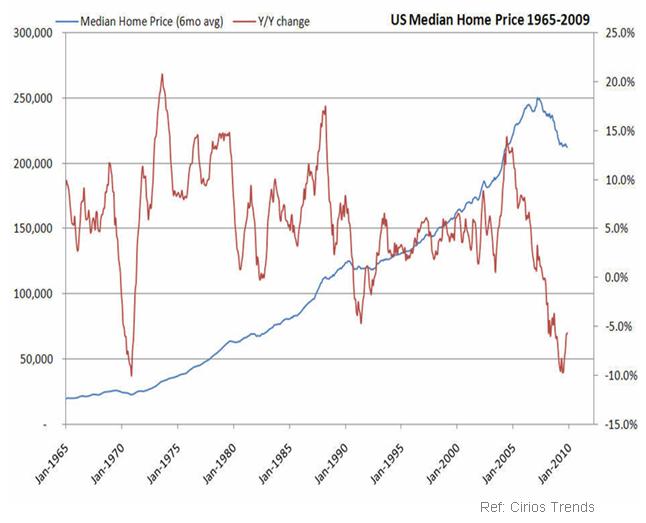
In the last 30 years, although sales of existing homes have gone up and down like a Roller Coaster, prices have increased at a steady pace.

US Median Home Prices 1965-2009

Below is an explanation of when & why prices went up..and then went down....and up again.

1979 - 1982: In October, 1979, Fed Chairman, Paul Volcker, restricted the growth of the money supply, which in turn, caused interest rates to skyrocket.


Interest rates rose from 12.5% (Sept. 1979) to the peak of 17.48% in 1982!

Inflation plagued the economy and unemployment rose from 5.9% in 1979 to 10.8% in December 1982, which put the U.S. in a deep recession. EXISTING HOME SALES DROP 61%!

1982 - 1987: Congress stepped in and deregulated Savings & Loans. This gave them the power to invest directly in service corporations, make real estate loans without regard to the geographical location of the loan, and authorized them to hold up to 40 percent of their assets as commercial real estate loans. REAL ESTATE BOOMS!!!

1988 - 1992: The Savings & Loan Crisis HITS. 747 S&Ls in the United States FAIL. REMEMBER THE "KEATING FIVE"?

President Bush Sr. enacts the S&L Bailout Plan. SOUND FAMILIAR?

The ultimate cost of the S&L crisis is estimated to have totaled around $160.1 billion, about $124.6 billion of which was directly paid for by the U.S. taxpayer. SOUND FAMILIAR?

The accompanying slowdown in the Finance Industry and the Real Estate Market may have been a contributing cause of the 1990-1991 economic recession. EXISTING HOME SALES DROP 25%!

1993 - 2000: Interest rates drop, fluctuating from 8.12% in 1993 to 8.32% in 2002. EXISTING HOME SALES ARE ON THE RISE AND PRICES INCREASE AT A STEADY RATE

CAN YOU SAY .COM? Tech Stock becomes KING. Companies see their stock price shoot up when they add .com after their name. Life is GOOD....for a while anyway.

The dot-com bubble burst on March 10, 2000. The crash wiped out $5 trillion in market value of technology companies from March 2000 to October 2000.

2001 - 2007: Enter Alan Greenspan. In an effort to bring us out of a recession after the .com BUST and 9/11, Greenspan dramatically eases credit.

Baby Boomers decide that the stock market won't provide them with sufficient assets to retire. They take advantage of real estate markets and low down payments to speculate in residential real estate.

Investors step in, buy up as much as possible and lie about owners occupying homes.

Buyers overbid because they thought they could FLIP the house and make a killing.

Lenders provide loans to Buyers who could not qualify. THE REAL ESTATE MARKET GOES CRAZY!

HOMES SELL LIKE HOTCAKES AND PRICES ARE DRIVEN UP TO RECORD LEVELS!

It seems that this market will last forever and we will all be rich!

2007 - 2009: Oops! The BUBBLE BURSTS. It had to end, right?


The Bad News: HISTORY REPEATS ITSELF.

The Good News: HISTORY REPEATS ITSELF.

With the DRAMATIC increase in prices from 2001 - 2007, the Market HAD TO correct itself...DRAMATICALLY!


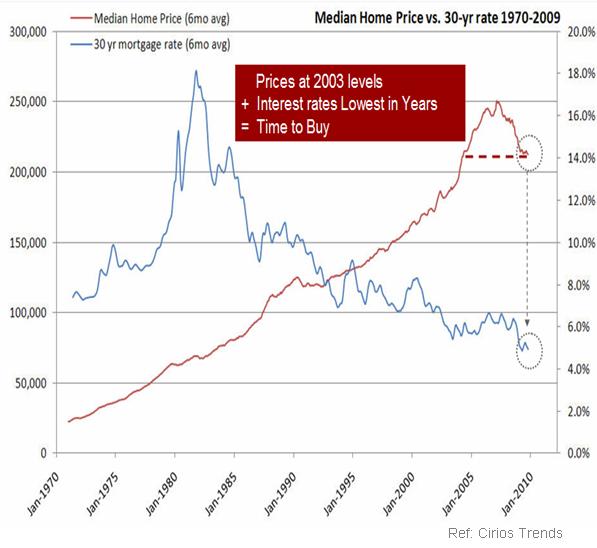
Home prices have rolled back to 2003 levels and as you can see by the chart below, interest rates are still at record lows.

Median Sales Price vs. 30 yr Interest Rate


Sunday, October 24, 2010

10 Reasons to Buy a Home

Enough with the doom and gloom about homeownership.

Sure, maybe there's more pain to come in the housing market. But when Time magazine starts running covers that declare "Owning a home may no longer make economic sense," it's time to say: Enough is enough. This is what "capitulation" looks like. Everyone has given up.

After all, at the peak of the bubble five years ago, Time had a different take. "Home Sweet Home," declared its cover then, as it celebrated the boom and asked: "Will your house make you rich?"

But it's not enough just to be contrarian. So here are 10 reasons why it's good to buy a home.

1. You can get a good deal. Especially if you play hardball. This is a buyer's market. Most of the other buyers have now vanished, as the tax credits on purchases have just expired. We're four to five years into the biggest housing bust in modern history. And prices have come down a long way– about 30% from their peak, according to Standard & Poor's Case-Shiller Index, which tracks home prices in 20 big cities. Yes, it's mixed. New York is only down 20%. Arizona has halved. Will prices fall further? Sure, they could. You'll never catch the bottom. It doesn't really matter so much in the long haul.

Where is fair value? Fund manager Jeremy Grantham at GMO, who predicted the bust with remarkable accuracy, said two years ago that home prices needed to fall another 17% to reach fair value in relation to household incomes. Case-Shiller since then: Down 18%.

2. Mortgages are cheap. You can get a 30-year loan for around 4.3%. What's not to like? These are the lowest rates on record. As recently as two years ago they were about 6.3%. That drop slashes your monthly repayment by a fifth. If inflation picks up, you won't see these mortgage rates again in your lifetime. And if we get deflation, and rates fall further, you can refi.

3. You'll save on taxes. You can deduct the mortgage interest from your income taxes. You can deduct your real estate taxes. And you'll get a tax break on capital gains–if any–when you sell. Sure, you'll need to do your math. You'll only get the income tax break if you itemize your deductions, and many people may be better off taking the standard deduction instead. The breaks are more valuable the more you earn, and the bigger your mortgage. But many people will find that these tax breaks mean owning costs them less, often a lot less, than renting.


4. It'll be yours. You can have the kitchen and bathrooms you want. You can move the walls, build an extension–zoning permitted–or paint everything bright orange. Few landlords are so indulgent; for renters, these types of changes are often impossible. You'll feel better about your own place if you own it than if you rent. Many years ago, when I was working for a political campaign in England, I toured a working-class northern town. Mrs. Thatcher had just begun selling off public housing to the tenants. "You can tell the ones that have been bought," said my local guide. "They've painted the front door. It's the first thing people do when they buy." It was a small sign that said something big.


5. You'll get a better home. In many parts of the country it can be really hard to find a good rental. All the best places are sold as condos. Money talks. Once again, this is a case by case issue: In Miami right now there are so many vacant luxury condos that owners will rent them out for a fraction of the cost of owning. But few places are so favored. Generally speaking, if you want the best home in the best neighborhood, you're better off buying.

6. It offers some inflation protection. No, it's not perfect. But studies by Professor Karl "Chip" Case (of Case-Shiller), and others, suggest that over the long-term housing has tended to beat inflation by a couple of percentage points a year. That's valuable inflation insurance, especially if you're young and raising a family and thinking about the next 30 or 40 years. In the recent past, inflation-protected government bonds, or TIPS, offered an easier form of inflation insurance. But yields there have plummeted of late. That also makes homeownership look a little better by contrast.

7. It's risk capital. No, your home isn't the stock market and you shouldn't view it as the way to get rich. But if the economy does surprise us all and start booming, sooner or later real estate prices will head up again, too. One lesson from the last few years is that stocks are incredibly hard for most normal people to own in large quantities–for practical as well as psychological reasons. Equity in a home is another way of linking part of your portfolio to the long-term growth of the economy–if it happens–and still managing to sleep at night.

8. It's forced savings. If you can rent an apartment for $2,000 month instead of buying one for $2,400 a month, renting may make sense. But will you save that $400 for your future? A lot of people won't. Most, I dare say. Once again, you have to do your math, but the part of your mortgage payment that goes to principal repayment isn't a cost. You're just paying yourself by building equity. As a forced monthly saving, it's a good discipline.

9. There is a lot to choose from. There is a glut of homes in most of the country. The National Association of Realtors puts the current inventory at around 4 million homes. That's below last year's peak, but well above typical levels, and enough for about a year's worth of sales. More keeping coming onto the market, too, as the banks slowly unload their inventory of unsold properties. That means great choice, as well as great prices.

10. Sooner or later, the market will clear. Demand and supply will meet. The population is forecast to grow by more than 100 million people over the next 40 years. That means maybe 40 million new households looking for homes. Meanwhile, this housing glut will work itself out. Many of the homes will be bought. But many more will simply be destroyed–either deliberately, or by inaction. This is already happening. Even two years ago, when I toured the housing slump in western Florida, I saw bankrupt condo developments that were fast becoming derelict. And, finally, a lot of the "glut" simply won't matter: It's concentrated in a few areas, like Florida and Nevada. Unless you live there, the glut won't have any long-term impact on housing supply in your town.


Article courtesy of WSJ

Thursday, October 14, 2010

How Does the Interest Rate affect the Price of a Home?


That sounds like a simple question.

Of course a lower rate means a lower monthly payment.

But how much of a difference does that really make.

I’ve heard people overly-simplify the issue by saying that a 1% change in rate is roughly the same as a 10% change in price. Let’s look into this a little closer and see if it holds up.

We’ve all heard that interest rates today are at all-time lows. I think we take that for granted, so it helps to include this chart that goes back to 1975.


It shows a 36-year average of mortgage rates.

The BLUE LINE is 30 year fixed rates and since that is the most popular program, that is what we will focus on.

As you can see by the graph, mortgage rates in 2010 are truly lower than anything we have seen in our lifetimes.

Current average 30 year fixed mortgage rates are around 4.375%.

If you were to purchase a home with a $400,000 home loan, the monthly principal and interest payment at that rate would be $1,997.

Now let’s see how raising the rate to the 2000 average of 8.05% affects the payment. That’s not all that long ago.

The payment at same loan amount at the 2000 rate is $2,949.

We increased the rate by 3.675% and that resulted in a 48% increase in payment!

That seems worse than the 1% rate to 10% price ratio, but let’s look at it from a price perspective.

That increase in payment from $1,997 to $2,949 is the same as raising the loan amount from $400,000 to $590,646.

That is also a 48% increase in loan amount.

If the down payment is the same percentage for each example, then it also results in a 48% increase in sales price.

So for this example we discovered that a 3.675% increase in rate equals a 48% increase in price.

It also means a 1% increase in rate is equivalent to a 13% increase in sales price.


Don’t think I chose a year with an exceptionally high rate. I could have used 1981 where rates were 16.63%!

In fact, the average rate over the 36 years is 9%. I chose 2000 because it wasn’t that far back in history.

The lesson here is that we must recognize what an amazing opportunity we have to borrow money at this specific point in history.

Years from now we can look at an updated version of this graph and see the low point, and remember what a great deal we got in 2010.


Chris Mozilo NMLS# 183726; AZ LO-0912308; BKBR-0115591; CA-DOC 183726

Why the Large Percentage of Drop in Home Sales in July


Why Home Sales Dropped Dramatically in July from June
Or
Why Were We Surprised When Buyers Were Incentivized?


In the week of August 23, blasted throughout the news was existing home sales nationally dropped 27% in July from June.


This was reported as the biggest monthly percentage decline on record.

The Greater Phoenix residential market faired slightly better with a 24% decrease. A large percentage drop in July sales was expected for Greater Phoenix.

Why The Large Percentage Drop for Sales in July Was Expected

Why did sales drop in July?

Because the affect of the tax credit(s) were worn out!


Many buyers bought because of the two tax credits:

The first time homebuyer’s tax credit up to $8,000 and the move up buyer’s tax credit up to $6,500.

To qualify buyers had to be under contract by April 30, 2010 and close by June 30 (at the end of June the close of escrow date was extended to September 30).

The April 30 deadline led to a surge of buyers going under contract in March and April.

So, before you believe the Headlines in the News....look at the statistics...it's not all doom and gloom!

Hand Prints of Hope | Phoenix Children's Hospital

Julia drew her dream home.

And now, thanks to a group of caring business leaders, her beautiful art will be sold for a donation and hung in a caring corporate donor’s office, which in turn benefits the very hospital which saved her life.

The Williams Real Estate Company and its founder, Daniel Williams, came up with the idea after having his own office walls adorned with Phoenix Children’s Hospital patient artwork.

Williams kicked-off a program and assembled a dedicated group of business leaders that will take PCH children’s art to a new level, creating a year round business-to-business fundraising opportunity for Phoenix Children’s Hospital.

For more than 23 years, the Art Project at Phoenix Children’s Hospital Foundation started with just greeting cards designed by young patients, only available during the holidays. All proceeds benefit the Hospital’s Center for Cancer and Blood Disorders, helping fund medical and family support programs, research equipment, school re-entry programs, lodging at the Ronald McDonald House, and patient camps and retreats.

But, with funding cuts and hospital costs continually rising, the need for more creative and long-term fundraising endeavors are being created by committed Phoenix Children’s business leaders like Dan Williams.


“Our Real Estate Company is based on Philanthropy, and we always donate through every real estate transaction. Yet, there’s always more that can be done with business associates that I work with every day,” says Art Advisory Chairman, Williams.

Dan invited industry associate, Bill Rogers, President of Homeowners Financial Group to be the Co-Chairman of the business community “Art Advisory – Handprints of Hope”.

Together they launched an initial 50-member team of business leaders with a kick-off event at the W Hotel last July.


Business leaders will promote and sell “Handprints of Hope” artwork for PCH fundraising, while conducting their own daily business.

From City of Phoenix employees to business owners – each will help fundraise.


The Art Advisory goal is to raise $250,000, by selling framed PCH children’s art that ranges from $250 to $5000.

The large 5-piece format is for a collage of patient art, which also includes a tour of Phoenix Children’s, reception with the CEO, Bob Meyers, Foundation Directors and Doctors.

Proceeds benefit Phoenix Children’s Hospital.

Phoenix Children's Hospital has provided hope, healing, and the best healthcare for children and families since it was born in 1983. Today, Phoenix Children's is one of the ten largest children's hospitals in the country and provides specialty and sub-specialty inpatient, outpatient, trauma, and emergency care to patients throughout Arizona and other Southwestern states.

http://www.phoenixchildrens.com/